
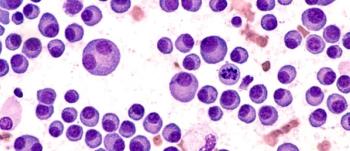
The long-term data comes from 2 cohorts in the phase 2 CARTITUDE-2 clinical trial.
The long-term data comes from 2 cohorts in the phase 2 CARTITUDE-2 clinical trial.
The pediatric gastroenterologist and professor in residence at University of California at San Francisco discussed the dose response seen with RGX-121.
The expanded donor Treg clones maintained lineage fidelity and were persistent through 1 year post-HCT.
The hematology coordinator for pharmacy at Froedtert and the Medical College of Wisconsin discussed the advantages of each of the 2 modalities in the third and second line settings.
The data comes from an expanded access protocol (EAP; JCAR017-EAP-001) that included 96 patients in total who were treated with the nonconforming product.
Juliane Gust, MD, PhD, an assistant professor of neurology at University of Washington, Seattle Children's, discussed a study that is currently underway via the NIH’s CARnation Consortium that will seek to address this gap in knowledge.
The associate professor of medicine at Medical College of Wisconsin discussed clinical results from patients with CLL and Richter’s transformation treated with CD19/CD20-targeted CAR-T LV20.19.

Going forward, the dose for patients with CLL has been reduced to 1x10⁶ cells/kg.
The pediatric oncology pharmacist at Mayo Clinic discussed the incorporation of the recently FDA-approved gene therapies for SCD and TDT into the work of pharmacists.
Beleaguered company AlloVir has shut down the program before moving on to phase 2.
The medical director of Pediatric Hematology/Oncology at Sarah Cannon Research Institute discussed the pros and cons of potentially curative treatment options for SCD.

Differences between IEC and non-IEC post-relapse outcomes showed some significance in PFS but not in ORR.
The researchers are continuing to investigate in vivo efficacy to pave the way to IND-enabling studies.
Patients with high bone marrow burden and CNS/non-CNS EMD were found to experience the worst OS and EFS outcomes.

Funding from ACGT will help Chiocca perform FDA-required studies on mice to show the oncolytic virus is safe and can be manufactured for humans. It is the second such grant awarded to Chiocca from ACGT.
The assistant professor at Mayo Clinic School of Medicine discussed the design of the phase 1 trial.
Peter A. Merkel, MD, MPH, the chief of the Division of Rheumatology and a professor of medicine and professor of epidemiology at Penn Medicine, discussed clinical trial design considerations for this emerging field.
The executive director of global clinical development at Ultragenyx Pharmaceutical discussed the statistical findings she presented at the 2024 WORLDSymposium.
David Porter, MD, the director of cell therapy and transplant at Penn Medicine, discussed the importance of sharing knowledge in the emerging field of cell therapy for autoimmune disease.
The chief of the Division of Rheumatology and professor of medicine and professor of epidemiology at Penn Medicine discussed challenges on the horizon in this rapidly emerging field.
Barry J Byrne, MD, PhD, the chief medical advisor of MDA, discussed what he views as the next horizon in the field of gene therapy.
The executive director of global clinical development at Ultragenyx Pharmaceutical discussed UX111, the company’s investigational gene therapy for MPSIIIA.
Barry J Byrne, MD, PhD, the chief medical advisor of MDA, discussed his research on a new application of efgartigimod alfa (Vyvgart).
The chief of the Division of Rheumatology and professor of medicine and professor of epidemiology at Penn Medicine discussed the panel he participated in at the inaugural Cell Therapy for Autoimmune Disease Summit.
The clinical assistant professor at Stanford Medicine discussed potential applications for machine learning in analyzing data in medicine.
The gene-edited cell therapy also showed a safety profile consistent with that previously seen in patients with early-onset MLD.

Data from defunct company Lysogene’s discontinued trial of LYS-GM101 were presented at WORLDSymposium.

Among the 5 patients treated in the study, sustained supraphysiological expression of the disease-targeted gene, SGSH, was rapidly achieved in the leukocytes and the plasma.
Hematological recovery was achieved and maintained in all 4 patients in the study.
Orchard Therapeutics has also randomized the first patient with Hurler Syndrome in the phase 3, registrational HURCULES trial of OTL-203 gene therapy.